
Weekly Newsletters
The APEX Newsletters are a collection of our weekly email messages to the APEX community. Here, we share updates from our work, research-based insights, and reflections on breath, mindset, and performance. Each message offers a window into the practices, principles, and purpose that guide our training and teaching.
-
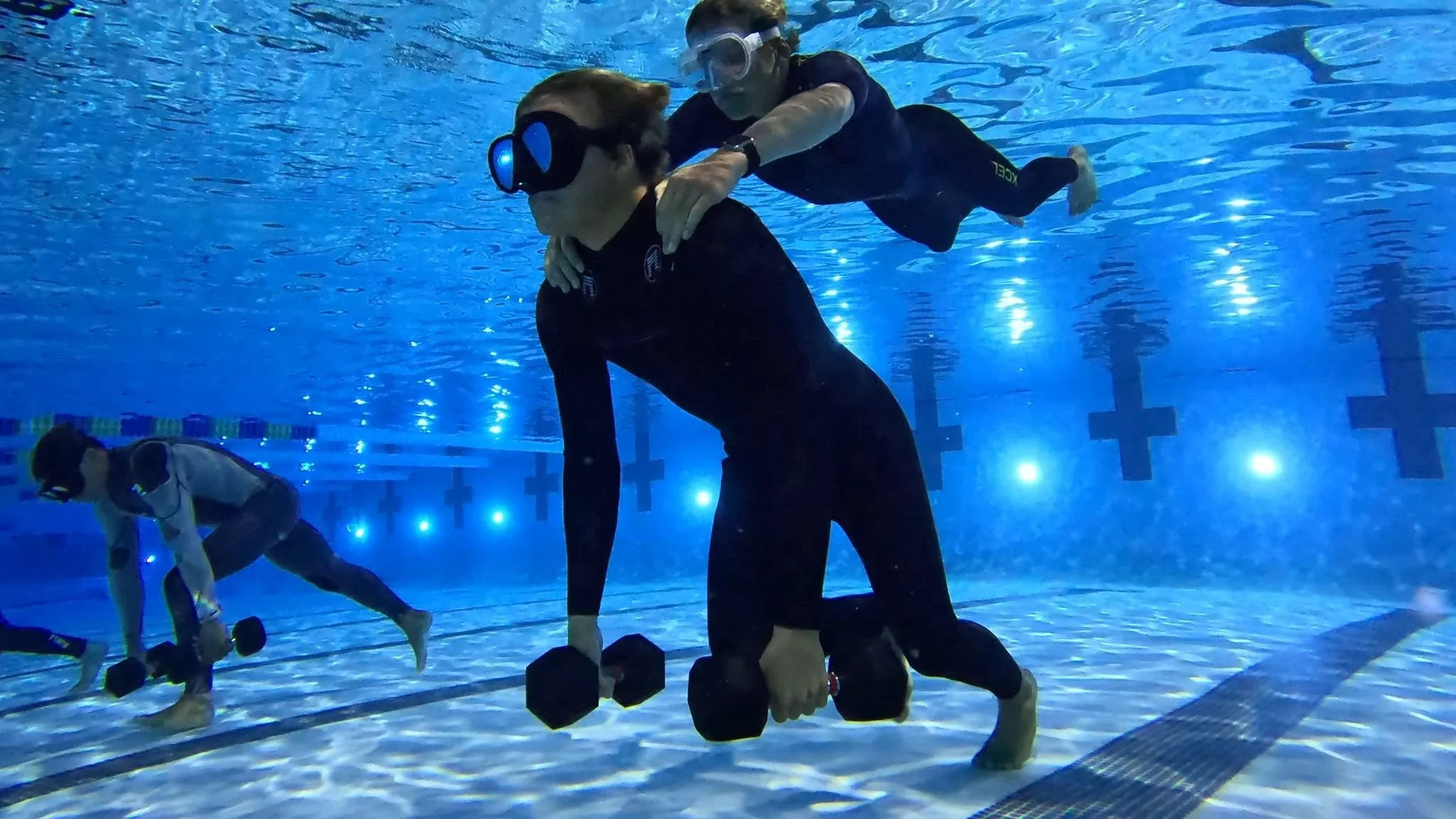
Recently, we had the privilege of working alongside Uar Bernard and an exceptional NFL International Player Pathway staff—deeply committed to developing talent at the highest level.
Uar Bernard is originally from Nigeria, where he was playing basketball just a few years ago before transitioning into American football. At 6’5”, over 300 pounds, and remarkably lean, his profile is rare. At the NFL Combine, he translated that into performance—posting a 4.63-second 40-yard dash, a 10'10" broad jump, and a perfect 10.0 Relative Athletic Score.
From the outside, it’s easy to focus on what stands out immediately—power, speed, and what many would call “generational talent.” But step into the work—and a different story begins to unfold, because talent may open the door, but it is not what walks you through it. What we witnessed—and what we train—is what sits beneath those numbers.
The discipline to show up again.
The willingness to be coached.
The humility to start where you are—not where others expect you to be.Because when an athlete transitions into a new level—or even a new sport—the edge is no longer talent alone, it is the ability to build access under pressure– and this is where our work begins– not with output, but with state. Because performance is not determined first by what you can do—but by whether you can access it when it matters.
This is why our training—on land and in the water—looks the way it does. On land, we challenge the system–breath under load, movement under constraint, effort paired with awareness. In the pool, we refine it– composure under pressure, stillness within discomfort, clarity when the urge to react rises. These are not just workouts. They are conditions for learning. Because grit, mindset, and deliberate practice are principles that refine our body and mind.With intentional training over time, effort becomes more efficient, recovery more deliberate, and decisions more precise—not because talent has changed, but because access has expanded—and that is where performance is built, one breath, one rep, one choice at a time.
-
IGrit is often celebrated as a cornerstone of peak performance. Psychologist Angela Duckworth defines grit as passion and perseverance for long-term goals—the ability to stay committed, to show up consistently, and to keep going when progress feels slow or obstacles arise.
Goals are written in pen. Plans are written in pencil. Within this understanding, grit is what holds the goal steady—the resolve to continue. It is the driving force behind our mission and vision—the energy that keeps us moving forward, even when the path is unclear.
But grit alone is not enough, because the path toward any meaningful goal is rarely linear. There are bends in the road, unexpected resistance, and moments that ask us to pause, reflect, and adjust. This is where grace enters. If grit is the discipline to hold on, grace is the wisdom to let go. Grace reminds us that adjusting the plan is not the same as abandoning the goal. It allows us to release what is no longer serving us—without losing sight of what matters most.
Grace is the compass. It guides how we move, how we respond, and how we stay aligned with our character and values—especially when things don’t go as planned. Grace is forgiveness of ourselves when we fall short, of others when expectations are not met, and of the process when it unfolds differently than we imagined.
Without grace, grit can become rigid—pushing us forward without awareness, without adaptation, and sometimes at a cost. We press on when we should pivot. We hold tightly when we would be better served by letting go.
Grace softens the edges. It shows up internally—in how we speak to ourselves when things don’t go as planned. It shows up externally—in how we navigate relationships, especially when others don’t fully understand or support our path.
To move with both grit and grace is to be strong in conviction, but not hardened in heart. It is perseverance without pressure, discipline without rigidity, and commitment without attachment.
Grit and grace together is steel in a satin glove. And it is this balance—firm yet flexible, disciplined yet adaptive—that allows us not only to pursue our goals, but to grow—deliberately, intentionally—through the process of becoming.
This week, notice where grit shows up and where grace is needed.Hold steady when it matters. Let go when it serves you. Because performance in the water—and in life is not just about how long you can push,but how well you can adjust. Steel in a satin glove.tem description
-
Peak performance does not demand rigidity. It requires awareness, prioritization, and intentional decision-making. Some seasons call for deep effort, others call for restoration. The key is not the rule–the key is discernment.—and discernment rarely emerges in a rushed mind. It requires space—moments where the nervous system settles enough for clarity to surface.
This is why foundational practices matter:
Movement.
Breathwork.
Meditation.
Time outdoors.
Moments of stillness.At times, it also means stepping away. Taking time to focus on personal and professional growth and wellness is not a withdrawal from responsibility. It is not abandoning the people or commitments that matter. It is an intentional investment in the capacity required to return with greater clarity, presence, and purpose.
In high-performance environments, this can feel counterintuitive. The instinct is often to stay engaged, to remain available, to say yes–but growth requires space. And space allows us to recalibrate, reconnect with what matters, and restore energy.
These practices are not luxuries. They are performance tools that create the conditions for wise decisions. Because when the mind settles and the breath slows, priorities become clear.
Let’s give ourselves permission to pause, take a breath, and choose our yes with clarity and intention.
-
For many people, the first experience underwater with a speargun brings an immediate surge of adrenaline. The ocean feels vast, the senses sharpen, and excitement takes over. In that heightened state, something curious often happens: fish that are directly in front of the diver go unnoticed. Movements become quick and reactive. The diver scans, turns, and searches—often scaring away the very fish they hope to see.
The instinct is to move faster. But experience teaches spearfishers that the opposite is true. The ocean rewards patience. When the breath slows and the body relaxes, everything changes. As diver becomes calmer in the water, vision softens and expands, and fish that seemed absent a moment before begin to appear. Sometimes they swim closer out of curiosity. What once felt empty becomes full of life.
The difference is not equipment, strength, or luck. The difference is breath. Breath training teaches the body to remain calm when the nervous system would normally accelerate. Instead of reacting to adrenaline, the diver learns to regulate it. Heart rate slows, muscles relax, and attention sharpens. What looked chaotic becomes clear.
In performance science, this is the power of autonomic regulation—our ability to influence the balance between the sympathetic “fight or flight” response and the parasympathetic “rest and regulate” system. The breath sits directly at that intersection.
When breathing becomes fast and shallow, the nervous system receives signals that something is wrong. The body prepares for urgency. Attention narrows and patience disappears. When breathing becomes slower and more controlled—particularly when the exhale lengthens—the vagus nerve helps signal safety to the body. Heart rate begins to settle. The mind regains clarity and perspective.
In other words, breath creates access.
Access to patience.
Access to clarity.
Access to better decisions.Spearfishing simply makes this relationship visible. But the same principle appears everywhere in daily life.
Patience with a child navigating big emotions.
Patience with an aging parent struggling with memory.
Patience in a long airport line or unexpected traffic.
Patience in the small moments where irritation could easily take over.In each of these situations, the body experiences a subtle stress response and the nervous system begins to accelerate. Without realizing it, breathing changes, tension builds, and reactions become faster and sharper. Yet the same tool used underwater remains available in those moments: the breath.
A single slower inhale followed by a longer, controlled exhale may seem simple, but physiologically it begins to restore balance. The nervous system settles, emotional reactivity softens, perspective returns, and patience becomes possible again. This is why we often describe breathwork as an investment. Like many worthwhile investments, the gains are not always visible immediately. But over time, the returns compound.
Each deliberate practice strengthens the body’s ability to remain steady under pressure. Over time, the nervous system learns to shift more easily from reactivity to regulation. Calm becomes more accessible—not only in training, but in the unpredictable moments of everyday life. With consistent practice, patience becomes less something we try to summon and more something the body remembers.
In the water, that patience allows the diver to see what others miss. On land, it allows us to respond to life with greater clarity, presence, and care. And in both places, the return on that investment is profound.
This week we invite you to register for our upcoming underwater apnea sessions. These classes provide a powerful environment to deepen breath awareness, cultivate calm under pressure, and strengthen the patience that supports both performance and presence.
After all, patience is often the true payoff of breath training. And if you're spearfishing, it might just get you dinner, too.
-
Transitions show up in our lives in many forms.
Some are subtle—the quiet pause before a meeting begins, the shift between lessons, the moment we take a breath and refocus between tasks. Others are far more pronounced: a new direction for a program, a shift in leadership, a reimagined brand, or a cultural moment that unsettles the ground beneath our feet.
And sometimes transitions arrive in deeply personal ways—a wedding, a graduation, a relationship change, a move across the country, or the unexpected loss of a job.
Ideally, transitions create space—an opening between what was and what will be. When we embrace that space, it becomes a threshold: a moment where the old has loosened its grip, but the new has not yet fully arrived. That in-between can feel uncomfortable, even disorienting. Yet it is also where possibility lives.
How we meet that space—whether we resist it, rush through it, or lean into it with presence—makes all the difference.xIn these moments, one of the most powerful tools available is surprisingly simple: breath.
Breath becomes a bridge between no longer and not yet. It steadies us in uncertainty and creates the space needed to respond with intention rather than react from tension. Whether the transition is small—moving between tasks during a busy day—or life-altering, breath allows us to move forward with greater clarity and composure.
One of the most powerful truths about human interaction is that the state we bring into a space shapes what happens next. Long before a word is spoken, people sense presence. Our nervous systems arrive first.
Calm or chaotic.
Grounded or scattered.
Steady or reactive.A regulated person can shift the emotional temperature of an entire room. A parent calming a worried child. A teacher steadying a classroom. A firefighter bringing composure to a tense scene. A nurse offering reassurance in the middle of uncertainty.
The opposite is also true. When tension or overwhelm enters a space, others feel it quickly. This is why how we move through moments of transition matters so much. The internal state we carry quietly influences the experience unfolding around us.
Breath gives us a way to shape that state. A single intentional breath can slow the rush of reaction and create space for clarity. In moments of uncertainty, breath becomes a steadying force—helping us move through change with greater composure and presence.
Transitions are not empty stretches between destinations. They are the spaces where clarity emerges and the next chapter quietly begins to take shape.
Whether it is the small shift between daily tasks or a major life change, the space between no longer and not yet holds real power. When we rush through it, old patterns often carry forward unchecked. But when we pause—even for a single intentional breath—we create room for something new to emerge.
And sometimes that simple act—breathing, resetting, and stepping forward with presence—is what helps carry us smoothly across the bridge from what was… to what will be.
-
At an NFL Scouting Combine, everything is measured. Speed is timed. Strength is counted. Power is captured.
5.12 seconds in the 40-yard dash.
32 reps at 225 pounds.
9 feet in the broad jump.Numbers matter. They open doors, create opportunity, and separate good from elite.
This week, however, as we worked alongside offensive line coach Eugene Chung preparing the 2026 cohort of the NFL International Player Pathway Program, we were reminded of a different measurement — one you won’t find printed on a stat sheet, yet one that may ultimately determine who sustains success.
18 inches–The distance between the head and the heart.
These young men arrived from Australia, Germany, Kenya, New Zealand, and Nigeria. Many are transitioning from rugby, soccer, basketball, and volleyball into professional American football. The learning curve is steep, expectations are high, and the margin for error is razor thin.
In the meeting room, their heads were fully engaged — absorbing terminology, assignments, timing, and performance mechanics. At this level, football is technical and exacting. One missed detail can unravel an entire play.
On the turf, their hearts were unmistakable. Their movement was deliberate, their posture purposeful. There was a quiet awareness that they represented more than themselves — family, country, possibility. Passion drove their effort and belief steadied their resilience.
Performance depends on both a disciplined mind and a strong heart, and sustained achievement depends on the eighteen inches that connect them. It is forged in the space between information and emotion — in the instant after a missed rep, a firm correction, or the onset of fatigue. There is always a moment, often less than a second, when a decision must be made.
Defend — or listen.
React — or reset.
Force — or refocus.Those decisions live in the eighteen inches between head and heart. And at the center of that space sit the lungs.
In high-pressure moments, the nervous system accelerates. Heart rate rises. Muscles tighten. Without regulation, emotion can override execution. But when breathing steadies, the system stabilizes, and the brain remains clear.
Breath becomes the connector — the dynamic link between head and heart. It keeps the technical precise and the emotional steady. It allows decisions to be informed rather than impulsive. This week, we trained that connector in real time — between correction and response, between fatigue and focus, between pressure and execution.
Ambitious, competitive, and driven, these athletes already possess the visible qualities of elite performers. By strengthening the eighteen inches that connect head and heart, we are reinforcing something less visible but far more enduring — their ability to remain grounded, coachable, and disciplined when the stakes rise.
Head informed.
Heart committed.
Decisions aligned.The stopwatch will record their time. The barbell will measure their strength. But alignment — measured in inches– will shape how they respond under pressure, how they lead, and how they endure.
It was an honor to support these athletes not only in preparing for measurable performance, but in strengthening the invisible connection that transforms knowledge into execution and passion into disciplined action. Because in the end, achievement is not defined solely by seconds on a stopwatch or pounds on a barbell. It is revealed in the alignment of head and heart when decisions matter most.
-
In dynamic environments, performance is rarely about executing a flawless plan. It’s about responding well when conditions inevitably change. Adaptability is not a backup skill—it is the skill. The ocean teaches this better than almost anything else.
Seasoned surfers know there is no guarantee that conditions will match the forecast or the mental rehearsal. The wave arrives as it is—not as hoped, predicted, or planned. Wind shifts. Tides change. Energy moves differently than expected. In that moment, the surfer has a choice: resist reality, or respond to it.
When conditions shift—and they always do—rigidity becomes a liability. The surfer who insists on the wave they wanted often misses the wave that’s actually rideable. The one who stays observant, regulated, and responsive adjusts positioning, timing, breath, and effort in real time. They don’t force the ocean to comply. They work with it.
This is where adaptability becomes a performance skill. Adaptability keeps us engaged without forcing outcomes. It preserves momentum. It allows us to stay present rather than frustrated. Disruption becomes information instead of a threat.
The same principle applies far beyond the water. In life, we often treat stress as a sign that something has gone wrong—when in reality, stress is feedback. It’s data about changing conditions, rising demands, or the need to adjust our approach. When we rigidly cling to how things should be, stress escalates. When we adapt—by shifting expectations, effort, pacing, or perspective—stress becomes manageable and even useful.
Goals belong in pen. They give direction, purpose, and commitment. Plans belong in pencil. They allow for adjustment, learning, and responsiveness.
In training, adaptability may look like adjusting effort rather than abandoning the session. Changing pace. Refining focus. Softening the breath. Choosing recovery when intensity isn’t available. Progress continues—not because the plan was followed perfectly, but because engagement was maintained.
The same is true in leadership, relationships, parenting, and personal growth. Adaptability doesn’t mean lowering standards or giving up on goals. It means meeting reality with skill. It means regulating first, responding second, and choosing the next right action rather than reacting emotionally to unmet expectations.
When patience and continuous improvement are already part of the process, adaptability becomes natural. We stop chasing ideal conditions and start working effectively with the ones we have. The goal remains steady. The approach evolves.
And that ability—to respond, adjust, and continue forward—is what sustains performance, resilience, and well-being over time.
-
In Chinese tradition, 2026 marks the Year of the Horse—a symbol of endurance, strength, and forward drive. Not speed, but sustained movement built through rhythm and consistency. That is the momentum we’re cultivating at APEX this year—steady, intentional, and built to last.
January was about showing up—week after week—to train the breath, steady the nervous system, and lay a foundation for sustainable performance. Quiet work. Repeated effort. Small practices done with intention.
February invites us to carry that work forward by continuing to return to what matters most.
Consistency creates confidence. With each practice, the breath steadies, regulation becomes familiar, and trust is built. Confidence expands capacity. Focus holds longer, responses become clearer, and performance becomes more available under changing conditions.
This is where momentum begins—not as acceleration, but as growth integrated deeply enough to carry forward. Capacity sustains momentum not through force or urgency, but through readiness.
At APEX, momentum is not something we chase. It is something we generate—through presence, patience, and practice.
As we step into the Year of the Horse, this is the season to build momentum that lasts. The practices we commit to now become the foundation for steadiness, resilience, and performance throughout the year.
Join us in our weekly classes, where breath, regulation, and capacity are trained deliberately—step by step, with intention.
For those ready to deepen their practice, there is still time to sign up for our Molchanovs Wave 1 Freedive Course (February 20–22)—an immersive experience focused on foundational breathwork, diving technique, and nervous system readiness in the water.
Start where you are. Stay consistent. Let momentum follow.
-
Kaizen, a Japanese concept meaning “good change,” reflects a commitment to constant, continuous improvement. It reminds us that lasting progress is built on the quality of our work and our learning—not on quick wins or perfect outcomes. Through reflection, we assess what’s working, refine what isn’t, and steadily grow, both in training and in life.
When we commit to Kaizen, a meaningful mindset shift often follows—from the defensive posture of proving to the more open, productive stance of improving. The pressure to perform gives way to curiosity. Effort becomes intentional rather than forced. Growth becomes something we engage with, not something we chase.
One of the most important—and most underestimated—skills in this process is patience. In performance culture, it’s easy to expect progress to be immediate and obvious. But real growth rarely announces itself. It settles in quietly—through consistent effort, thoughtful reflection, and repeated attention to the fundamentals.
In training, this may look like choosing presence over force. Refining a movement rather than chasing intensity. Returning to the same practice with slightly more awareness. These small, deliberate adjustments—made over time—are what allow learning to take root.
Patience allows integration. Integration builds access. And access is what shows up when pressure rises or circumstances shift. Over time, small refinements create stability—not rigidity—so we can respond effectively when things don’t unfold exactly as planned.
Kaizen reminds us that improvement is not about controlling every outcome, but about returning with intention—again and again.
You don’t need perfect days. Just a commitment to continuous improvement.
-
Last week, our message explored counting as a deliberate act of control—how giving attention a simple, repeatable job can interrupt fear, organize the mind, and stabilize the body under pressure. Counting with the breath is not a trick; it is a scaffold—a way of supporting the nervous system while capacity is being built. But scaffolds are not the structure. They exist to make something else possible.
In the early stages of apnea and underwater training, most people operate through conscious competence. Every movement is intentional. Breath is actively managed. Tasks such as rope work, carabiners, or knot sequences require sustained focus and careful mental tracking. Progress is real—but effortful. Control is present, yet fragile. This phase is where awareness forms and skills begin to organize—and it is also inherently limited.
Conscious competence depends on attention—and attention is a finite resource. Under fatigue, novelty, or rising stress, it wavers. What once felt accessible can quickly feel distant. The very tools that helped us stay regulated must be actively recalled in the moment. Practice is what changes that relationship.
With consistent, intentional exposure, the nervous system begins to integrate what was once consciously directed. Counting no longer needs to be consciously managed. Breath steadies without instruction. Hands move without hesitation. Decisions arise without internal narration. Skill shifts from something that must be held in mind to something that is available in the body—the hallmark of unconscious competence.
Through repeated exposure to controlled stress—paired with precision, recovery, and thoughtful variation—the nervous system learns what it can rely on. Skills embed not because stress disappears, but because the system has rehearsed regulation across changing conditions over time. This is where the difference becomes visible.
In the ocean, surfers describe this during hold-downs or heavy sets—moments when there is no time to “apply” a technique. Instead of panic, there is orientation. Instead of forcing control, there is response. Breath, awareness, and decision-making are simply present when needed.
The same principle holds across performance domains. In learning, leadership, athletics, professional settings, and daily life, what shows up under pressure is not what we know, but what we have practiced deeply enough to access without effort. Regulation does not need to be remembered. Calm does not need to be summoned. The response is already there.
Along the journey to excellence, access fluctuates. Even well-integrated skills can feel less accessible on certain days—the same environment, the same task, the same person, yet a different experience. This is not regression; it is reality. Human systems are adaptive, not mechanical. Automaticity is context-sensitive and strengthened through continued, varied practice.
Our peak performance framework does not treat breath, focus, or regulation as one-time skills or universal prescriptions. We recognize that each person is on a distinct trajectory toward excellence. Our instructional design is intentionally differentiated, with feedback loops that respond to where someone is today, attend to how their system is adapting, and align with the next step needed for integration.
Counting may be essential at one stage, while automatic regulation emerges at another—but both remain part of a living practice.
Peak performance is not about arriving; it is about building access. And that is what practice makes possible.
-
The picture book Sarah and the Big Wave tells the story of Sarah Gerhardt—the first woman to surf Mavericks. When Sarah is held under the water by a wave, she does something deceptively simple: she counts. What reads as a small detail turns out to be deeply instructive, and what appears instinctive is, in fact, very strategic. Neuroscience suggests we cannot meaningfully count and catastrophize at the same time.
Counting is a structured, goal-directed act that recruits executive control and working memory—the systems that allow us to aim attention deliberately and stay oriented under demand. When these systems are engaged, the brain’s default patterns associated with rumination and worry quiet—not because fear disappears, but because attention has been given a job.
The point isn’t that worry becomes impossible—it’s that counting makes worry harder to hijack attention, by intentionally occupying the same limited mental bandwidth with a deliberate, repeatable focus.This is not avoidance. It is intentional cognitive redirection—and it is a trainable skill.
Counting organizes the mind and breath stabilizes the body. When the two are paired, their effects are not merely additive—they are reinforcing. Counting alone is cognitively grounding. But counting with slow, intentional breathing becomes physiologically stabilizing. Research on paced breathing shows consistent effects on autonomic regulation, including increases in vagally mediated heart-rate variability (HRV), a marker of nervous system flexibility and stress resilience.
So, when we pair breath with counting, we are training two systems at once:
Cognitive anchoring — attention has a clear, repeatable job
Physiological support — arousal lowers and internal rhythm steadies
This is not incidental. It is intentional design—and it sits at the core of our APEX Peak Performance framework.
From classroom to competition, we embed the same skills, tools, and strategies because the nervous system does not change with the environment—only the demands do. Whether a child is navigating frustration in a kindergarten classroom or an athlete is managing physiological stress in the pool, the underlying requirement is the same: access to attention, regulation, and choice under pressure.
Young children may not yet carry “adult worry,” but they absolutely experience overwhelm, frustration, fear of making mistakes, and the panic of “I can’t do it.” Counting gives a child something concrete and doable in the moment: I know what to do. I can stay with this.
Breathing adds a felt sense of internal safety: My body can settle. I can get back in control. Together, counting and breath build agency—and agency is the cornerstone of resilience.This is the difference between being told to “calm down” and being taught how to create calm.The apnea work adults engage in is not simply breath-hold training—it is attention training under physiological demand. As CO₂ rises, the mind naturally begins to forecast danger: I can’t. I need air. Something’s wrong. Counting becomes a way to prevent attention from collapsing into that narrative, keeping the mind organized while the body is under demand. So in the pool, just as in the classroom, we are practicing the same essential capacity: Stay present. Stay oriented. Keep access.
What makes Sarah and the Big Wave such a powerful bridge is that it connects story, science, and performance—revealing how focus shapes what we can access under pressure. Sarah’s moment under the wave isn’t bravado—it is attentional control: choosing focus over fear in real time.
That is what we are teaching when we say, “Count with your breath.” Determination is not just personality. Resilience is not just toughness. Grit is trainable.
Count your breath — and count on us to support your focus, calm, and resilience.
-
Breathing is often viewed as a reaction—something that speeds up when we are stressed, slows down when we calm, and reflects what is already happening inside the body.
Current science tells a different story. Growing evidence across physiology, neuroscience, and psychology shows that breath is not merely a symptom of stress or exertion—it is a mechanism. When trained intentionally, breathing patterns can actively influence autonomic regulation, emotional resilience, cognitive clarity, and recovery. In other words, breath does not merely reflect our state—it helps create it.
Research demonstrates that slow, controlled breathing increases parasympathetic activity, enhances heart rate variability (HRV), and reduces both physiological and psychological stress. These changes reflect more than momentary calm; they indicate improved nervous system flexibility—the capacity to meet challenge without tipping into overwhelm.
What is especially compelling is how breath is trained. When breathing practices are introduced only in calm, quiet conditions, their benefits can be limited. But when breath is trained intentionally under load—during physical effort, elevated heart rate, or cognitive demand—the nervous system learns something essential: regulation can occur within stress, not just after it passes. This distinction matters.
Training breath under challenge improves tolerance to internal sensations such as rising heart rate, air hunger, and mental noise. Over time, these sensations are no longer interpreted as threats, but as manageable signals. The result is reduced panic reactivity, greater emotional steadiness, and clearer decision-making when it matters most.
From a physiological standpoint, controlled breathing under stress strengthens vagal pathways, allowing parasympathetic regulation to remain accessible even during sympathetic arousal. This translates into faster recovery between efforts, more efficient use of energy, and greater sustainability—whether in athletic performance, academic settings, or daily life.
Across populations and contexts, research consistently points to the same outcomes when breath is trained with intention:
Improved regulation during stress rather than avoidance of it
Reduced anxiety and threat reactivity
Faster physiological recovery after effort
Enhanced focus and cognitive clarity
Reliable transfer beyond training into real-world situations
The weekly training we do is often described as an “active meditation”—focused, composed attention that remains steady within challenge. This experience is supported by science. When breath is trained intentionally, regulation becomes accessible under real conditions, not only in moments of calm.
The takeaway is simple and powerful: breath is a trainable regulatory system.
Developed progressively, it shapes how we respond to pressure, recover from effort, and sustain performance over time.In a world that continually asks more of our nervous systems, breath offers something rare—not escape from challenge, but the capacity to meet it with steadiness, clarity, and resilience.
-
We are continually reminded that progress does not happen in isolation. Growth, resilience, and sustained performance are built through connection. Whether in training, teaching, coaching, or leadership, the environments that foster trust, belonging, and shared purpose are the ones where people thrive.
The work we do is inherently relational. We regulate together. We learn together. We move through challenges together. Community is not something added on after the fact—it is the foundation that allows individuals and teams to show up with clarity, consistency, and care.
Research continues to reinforce what many of us experience firsthand. Studies from the University of California, Berkeley examining NBA teams show that performance is not driven by individual talent alone, but by social connection—trust, cohesion, and the quality of relationships within a group. Strong relational bonds support better decision-making under pressure and more effective recovery from setbacks.
This insight extends far beyond sport. When people feel supported, they take healthier risks. When people feel connected, focus improves. When people feel part of something bigger than themselves, effort becomes sustainable.
This is why community matters.
This is why teamwork matters.
This is why we prioritize connection alongside performance.We are deeply grateful—for the trust placed in us, for the shared commitment to growth, and for the many ways this community shows up for one another. The joy in this work does not come from chasing outcomes; it comes from doing meaningful work together, grounded in connection and shared purpose—a lived expression of Ikigai, where passion, purpose, and contribution intersect.
Thank you for being part of this community. Thank you for the energy, care, and belief that how we work together truly matters.
-
As we begin a new year, many conversations focus on change—new goals, new habits, new energy. At APEX Peak Performance, we begin somewhere quieter and far more durable: foundation.
We often remind our athletes, educators, and leaders of a truth that can feel counterintuitive at first: Structure is not the enemy of freedom. It is the pathway to it.
When fundamentals are trained with intention—breath, body awareness, recovery, mindset, and systems—the nervous system settles. The mind grows quieter. The body becomes available.In that regulated state, something powerful emerges: access.
Access to choice.
Access to clarity.
Access to adaptability under pressure.We see this across environments—advanced apnea training, high-pressure professional settings, and leadership moments that demand precision rather than force. When breath patterns are trained, regulation becomes automatic.
When movement is rehearsed with care, the body responds without hesitation. When routines are established, energy is no longer spent managing chaos—it becomes available for presence, creativity, and flow.
This is why we emphasize deliberate structure:
Consistent breath practices
Thoughtful training progressions
Recovery rhythms that support adaptation
Mental frameworks that reduce noise
These are not constraints. They are anchors.
Peak performance is the ability to respond skillfully under pressure—again and again. When effort no longer competes with awareness, performance stabilizes. Decision-making sharpens. Recovery improves. Emotional regulation becomes reliable.
This is the difference between:
Occasional breakthroughs and consistent excellence
Motivation-driven effort and system-supported performance
Chasing flow and having access to it
At the start of the year, it’s easy to rush forward. Our work invites a different approach: build what lasts. Structure creates the conditions for clarity, steadiness, and sustainable performance—so energy is available where it matters most.
At APEX, we don’t train harder to access flow.
We train smarter—so flow is available when it counts.
-
We are in the midst of the holiday season—a time when schedules soften and routines naturally shift. Sleep looks different. Exercise becomes less predictable. Meals are richer, shared more slowly, and shaped as much by pleasure and connection as by purpose. This is not something to fix. It’s something to honor.
When priorities feel stretched, we often reach for the idea of balance. But balance implies equal distribution—everything held in careful proportion. Life doesn’t move that way, especially in seasons of celebration.
What serves us better is rhythm.
Rhythm is dynamic. It allows for ebb and flow—effort and ease, structure and spontaneity. When we shift from balance to rhythm, we move away from control and toward flow. Guilt gives way to grace.
What allows rhythm to work is not precision—but presence. And presence is where gratitude lives.
Savoring is gratitude in the moment. It’s choosing presence over pressure. It’s allowing a season to be what it is—without judgment or the need to “make up” for it later.
At APEX Peak Performance, our work is designed to support people across seasons. Breath becomes the steady thread—carrying us through full days and shifting routines, helping us return without judgment or force.
This week, we invite you to embrace the celebrations, soften the need for control, and savor the rhythm you’re in—with gratitude and grace.
We’re grateful to be moving through this season with you.
-
As the year winds down and routines soften, it’s natural to think of training as something we step away from during the holidays. At APEX Peak Performance, we see it differently.
Training—done with intention—is a gift. Not a demand. Not an obligation. But a practice that helps us stay capable, clear, and connected over time.
This perspective is echoed in the Disney+ documentary series Limitless, starring Chris Hemsworth. Rather than asking how far the human body can be pushed, the series begins with a more meaningful question:
What allows us to remain present, resilient, and engaged across a lifetime?
That question sits at the heart of the APEX Peak Performance Framework.
Peak Performance, as we define it, is not about intensity for its own sake. It is about alignment—the ability to sustain physical capacity, cognitive clarity, emotional regulation, and meaningful connection over time. When purpose leads, training shifts from excess to intention. The focus moves from doing more to doing what truly supports life.
The newly released Limitless episode, A Road Trip to Remember, is framed around shared experience, reflection, and time together. It reinforces a simple truth we see daily in our work: sustainable performance—both personal and professional—is built through rhythm, relationships, and support, not constant intensity.
Training isn’t about maintaining momentum at all costs. Strength, mobility, breath control, and nervous system regulation are not seasonal skills; they are long-term investments in how we move, think, and show up for the people who matter most.
As we move into our modified holiday schedule, we invite you to view training not as something to squeeze in—but as something to receive.
A way to stay grounded.
A way to remain capable.
A practice that supports presence, not pressure.Training is a gift—one that continues to give when approached with intention, rhythm, and care, allowing us to remain capable, present, and open to new limits across a lifetime.
We wish you a season of restoration, connection, and meaningful movement.
-
At APEX, everything we teach—mindset, breath, movement, recovery, leadership, and collaboration—is built on a simple, research-backed belief:Excellence is earned through intentional practice, shared commitment, and the courage to do the hard things that growth requires. This is our Performance Promise.
In Do Hard Things, performance scientist Steve Magness reframes what it means to be tough. True resilience, he explains, is not about pushing through with force or armor—it is about meeting challenge with clarity, skill, and presence.
Research shows us that:
Confidence is built through action, not affirmation
Resilience grows through small, repeated exposures to difficulty
The body and brain adapt when we engage—rather than avoid—effort
Mastery develops when we repeatedly choose the work that matters most
Hard things are not obstacles to avoid. They are the training ground for growth. At APEX, we intentionally design experiences—on land and in water—that introduce safe, structured difficulty. Not to overwhelm, but to expand capacity.
When athletes and students learn to regulate their breath under pressure, stay present in discomfort, think clearly when challenged, and recover with intention, they build more than physical skill. They strengthen their nervous system, sharpen their decision-making, and develop leadership that holds under stress.
This philosophy comes to life in our apnea training and freediving education—especially as we prepare to offer the Molchanovs WAVE 1 Freediving Course next weekend. WAVE 1 is not about depth or bravado; it is about foundational skill, calm under pressure, disciplined technique, and respect for the body and environment. It is structured challenge, taught with precision and care—exactly the kind of work that builds lasting capacity.
Peak Performance is not built in comfort.It is built through intentional practice, thoughtful challenge, and consistent support. This is how capacity expands. This is how confidence is earned. This is the standard we hold.